You poured hours into creating a beautiful design. You uploaded it to Merch by Amazon, and then - nothing. No sales, barely any views. Sound familiar? The problem often has nothing to do with the design itself. It comes down to keywords. On Amazon, a product that nobody can find is a product that nobody can buy. Mastering keyword research is one of the highest-leverage skills you can develop as an MBA seller, and it is something that separates hobbyists from sellers who build real, consistent income.
Why Keywords Matter on Merch by Amazon
Amazon is a search engine first and a marketplace second. When a customer types "funny dad fishing shirt" into the search bar, Amazon's algorithm scans millions of listings and surfaces the ones it considers most relevant and trustworthy. Your title, bullet points, and description are the primary signals that tell the algorithm what your product is about and who should see it.
This means your keyword strategy has a direct impact on visibility. A listing with well-researched, relevant keywords will consistently outperform a listing with a better design but poor keyword optimization. The algorithm does not reward creativity in isolation - it rewards relevance combined with good search intent matching.
Good keyword strategy also helps you reach the right buyers. Someone searching for "vintage motorcycle birthday gift for dad" is much further along in the buying journey than someone typing "shirt." Long-tail keywords like that first example may have lower search volume, but they attract buyers with clear intent, and those buyers convert at higher rates.
The takeaway: keywords are not a box to tick. They are the bridge between your design and the customer who would love it.
How to Use MerchIntel Keywords Analytics
MerchIntel's Keywords Analytics feature is purpose-built for MBA sellers. Unlike general SEO tools that pull data from the broader web, this feature is focused entirely on the Merch by Amazon marketplace - which means the data you get is directly actionable for your listings.
The interface is clean and straightforward. Here is how to use it effectively:
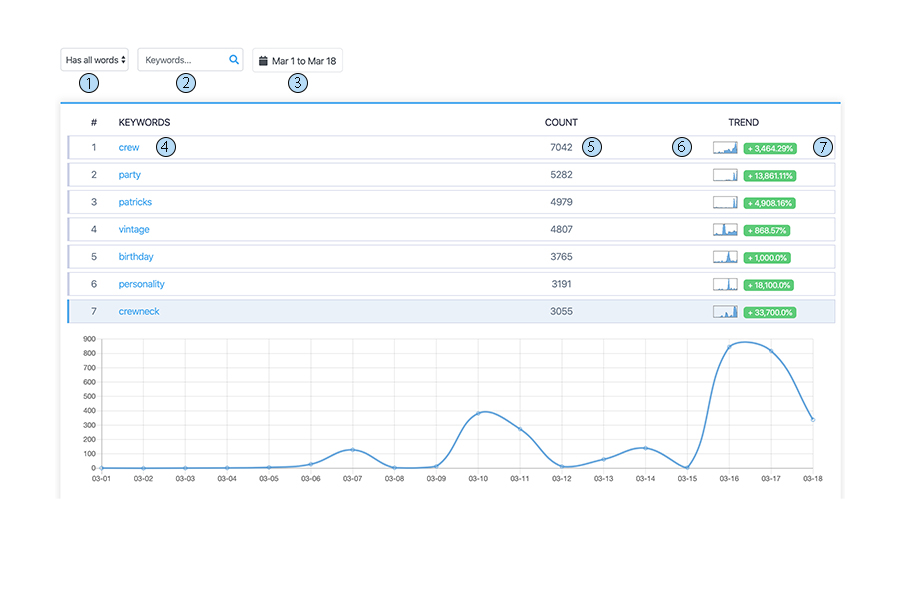
Step 1: Enter your keyword in the search box. Think about what a real customer would type to find a design like yours. Start with a core concept - "dog mom," "nurse life," "retired teacher" - and let MerchIntel surface the variations and related terms that are actually appearing on Amazon products.
Step 2: Select your search filter. You have four options: "has all words," "at least one," "occur in same order," and "match phrase." For broad exploration, use "at least one" to cast a wide net. When you want to find exact phrases customers search for, use "match phrase" or "occur in same order." Experimenting with these filters gives you different angles on the same keyword landscape.
Step 3: Set your time range and review results. Choose the time period you want to analyze - a recent two-month window is a solid starting point - and let MerchIntel run the search. Results appear in seconds and show you each matching keyword alongside its count, trend chart, and index score. You can click any keyword to automatically launch a Merch Research view showing designs that use that term.
Reading Keyword Results
Once your results load, you will see three key data points for each keyword. Understanding what they actually mean in practice is what turns raw data into smart decisions.
Count tells you how many products on Amazon currently include that keyword in their listing content. A high count means the keyword is widely used - which signals demand, but also competition. A low count on a keyword with a strong trend could indicate an emerging opportunity before the market catches up.
Trend chart shows how the keyword's usage has moved over the selected time period. Is it climbing, stable, or declining? A rising trend suggests growing customer interest. A declining trend may mean the moment has passed, or it could mean seasonal demand that will return. Flat trends often indicate evergreen keywords - reliable but competitive.
Index gives you a relative score that helps you compare keywords at a glance. Use it to prioritize which terms deserve a spot in your listings and which are too saturated or too obscure to be worth chasing.
Together, these three signals help you move from guessing to deciding with data.
Example: Researching Keywords in Practice
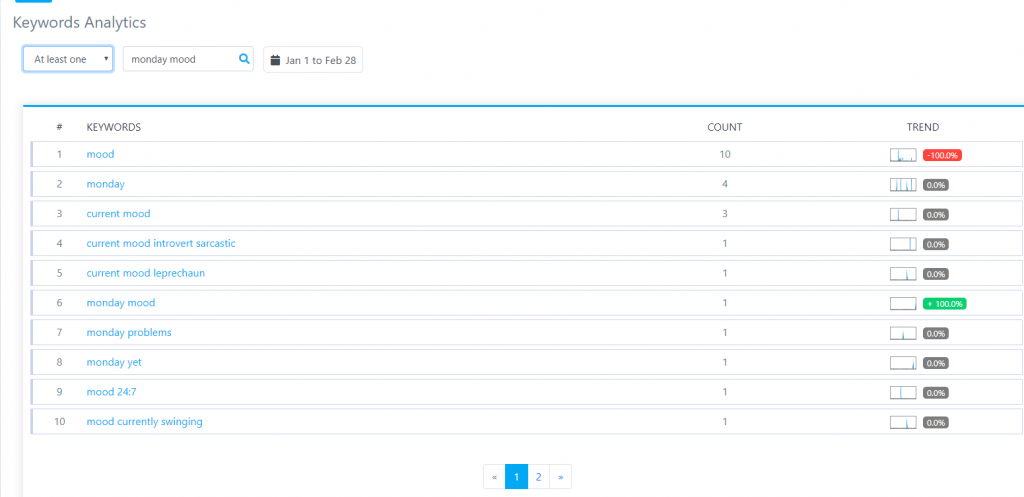
Let's walk through a real example. Say you are researching the keyword "Monday mood" using the "at least one" filter with a time range of January 1 to February 28.
MerchIntel returns two pages of results - around 12 related keyword variations - along with their individual counts, trend charts, and index scores. You might see variations like "Monday mood coffee," "case of the Mondays," or "hate Mondays" each performing differently. That spread of data tells you which angle resonates most with buyers right now.
From there, you can click on the best-performing variation to trigger a Merch Research view, showing you actual designs using that keyword. This helps you understand the competitive landscape and spot gaps your design could fill.
Keyword Strategy Best Practices
Having access to good data is only useful if you apply it with a sound strategy. Here are the principles that experienced MBA sellers use to get consistent results.
Relevance comes first. Always. A keyword only helps you if it accurately describes your product. Amazon's algorithm and its customers both reward relevance. Using keywords that do not match your design may generate impressions but will produce poor click-through rates and conversions - signals that tell Amazon to rank your listing lower over time.
Balance long-tail and short-tail keywords. Short-tail keywords like "funny shirt" have massive search volume but brutal competition. Long-tail keywords like "funny retirement shirt for teacher" are more specific, face less competition, and attract buyers with stronger purchase intent. A smart strategy uses both: short-tail for discoverability and long-tail for conversion.
Combine trending keywords with relevance. If a keyword is trending and it genuinely fits your design, use it. Seasonal trends (holidays, back to school, election season) represent real demand spikes you should take advantage of - as long as the keyword makes sense for what you are selling. Never force a trending keyword onto an unrelated product just to chase traffic.
Optimize across your full listing. Your keyword strategy does not live in just one field. Work your best keywords naturally into the product title (most important), bullet points, and description. The title carries the most ranking weight, so lead with your strongest, most relevant search terms.
Update keywords seasonally. Customer search behavior changes throughout the year. A keyword that performs well in November may be irrelevant in July. Build a habit of reviewing and refreshing your listings every few months, especially before major shopping seasons.
Common Keyword Mistakes to Avoid
Even sellers with good intentions make keyword errors that hurt their rankings. Here are the most common pitfalls to watch for.
Keyword stuffing. Cramming as many keywords as possible into a title or description does not fool Amazon - it just makes your listing harder to read and signals low quality to both the algorithm and potential buyers. Write naturally and let keywords fit the flow of the content.
Ignoring search intent. Not every search query is a purchase query. Someone typing "what is merch by amazon" is not ready to buy a shirt. Focus on keywords that signal buying intent - product descriptors, gift-oriented terms, occasion-based phrases.
Skipping seasonal updates. Listings left untouched for months lose relevance. Set a reminder to audit your top-performing listings at least once per quarter and adjust keywords based on current trends and upcoming seasons.
Copying competitor keywords blindly. Just because a successful seller uses certain keywords does not mean those keywords will work the same way for your product. Audit competitor listings for inspiration, but always validate whether a keyword genuinely fits your design and audience.
Using irrelevant trending keywords to chase traffic. This is one of the most damaging mistakes on the platform. Adding a trending keyword to a product it has nothing to do with can hurt your conversion rate, generate negative signals for Amazon's algorithm, and in some cases lead to listing suppression. Always prioritize relevance over reach.
Key Takeaways
- Keywords are the primary driver of discoverability on Merch by Amazon - a great design without good keywords will not reach its audience.
- MerchIntel's Keywords Analytics gives you marketplace-specific data (count, trend, index) to make informed decisions instead of guessing.
- Relevance is non-negotiable. Only use keywords that accurately describe your product.
- Build a balanced strategy using both long-tail and short-tail keywords, optimized across title, bullets, and description.
- Review and update keywords regularly to stay aligned with seasonal trends and shifting customer behavior.
Ready to stop guessing and start researching with real data? Try MerchIntel free for 14 days and see exactly what keywords are driving sales in your niche right now.